ReasFlow: Assisting Reasoning-Centric Scientific Discovery in Applied Mathematics via a Knowledge-Based Multi-Agent System
Abstract
Recent advances in Large Language Models have fueled autonomous AI agents capable of tackling complex scientific tasks, yet existing automated research systems remain predominantly focused on empirically driven domains with quantitative benchmarks, leaving theory‑driven discovery in applied mathematics largely underexplored. We introduce ReasFlow, an end‑to‑end autonomous agent system for reasoning‑centric scientific discovery in applied mathematics that operationalizes a collaborative paradigm where the human expert acts as Principal Investigator while the agent executes rigorous derivations as a capable graduate student. Taking distributed optimization as a concrete testbed, ReasFlow incorporates (i) a robust internal verification loop that audits logical coherence and corrects fundamental errors prior to human inspection, and (ii) an automated knowledge retrieval and self‑improvement mechanism that proactively surfaces both declarative facts and overlooked procedural heuristics. ReasFlow unifies the entire research pipeline—from comprehensive literature survey, novel algorithm design, and rigorous theorem proving, to numerical experimentation and polished manuscript writing—within a single cohesive architecture. Deployed to autonomously generate five complete research papers in this domain with rigorous theoretical and empirical content from minimal prompts, ReasFlow consistently achieves the highest evaluation scores among state‑of‑the‑art open‑access baselines under a curated LLM‑based review rubric. ReasFlow is publicly accessible via the ReasLab platform, providing a collaborative workspace for AI‑assisted theoretical research.
Results at a Glance
ReasFlow outperforms state‑of‑the‑art autonomous research systems across all critical dimensions, from mathematical rigor to presentation quality.
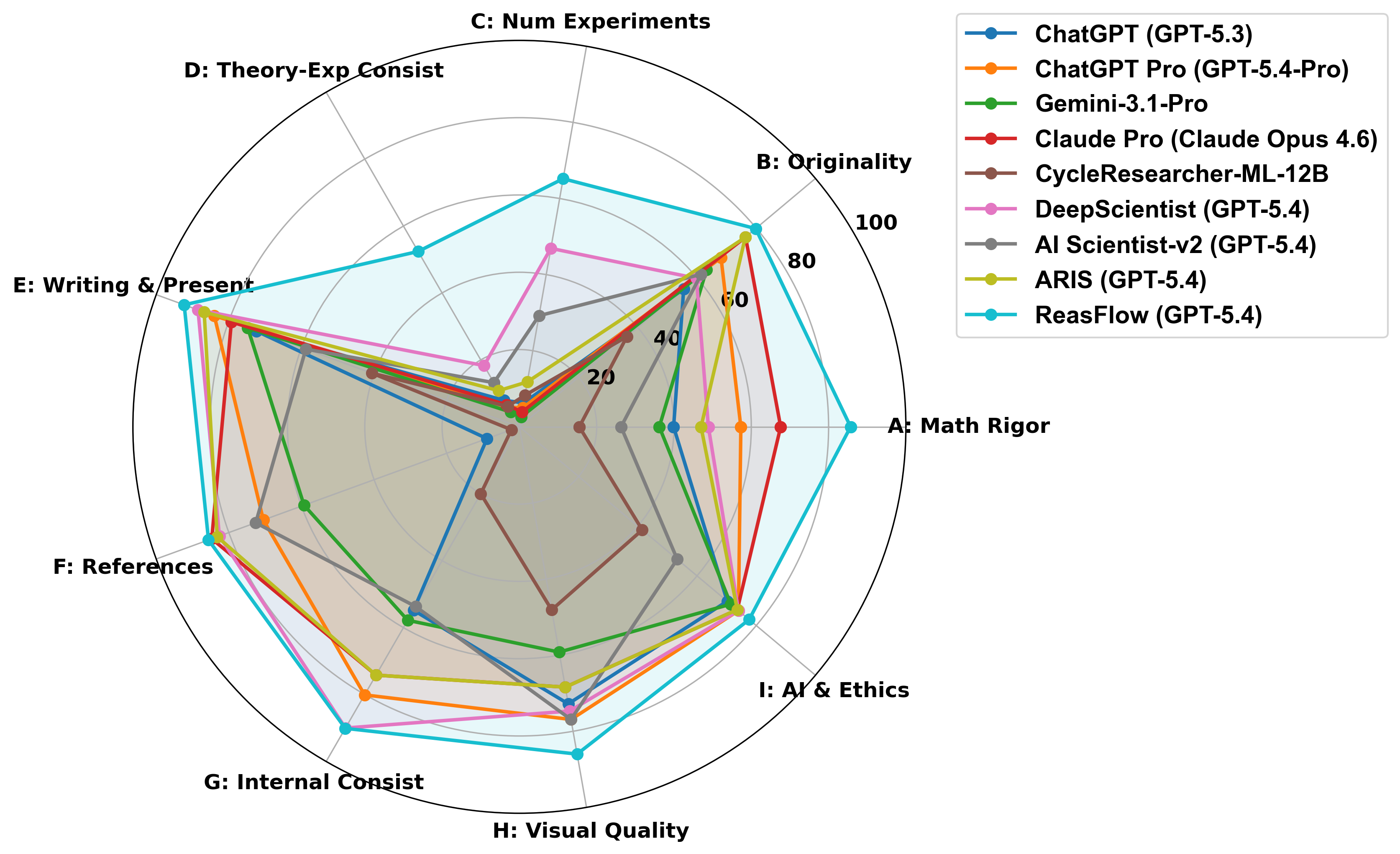
Figure 1. Multidimensional comparison of ReasFlow and other open-access systems across nine evaluation dimensions (scores normalized to 0–100).
Core Innovations
Reasoning‑Centric Discovery
ReasFlow is designed for theory‑driven research, where problems are open‑ended and success hinges on conceptual depth. The system autonomously formulates plausible assumptions, designs the theoretical statements to be proven, and constructs rigorous derivations—going far beyond solving well‑posed competition problems.
End‑to‑End Research Workspace
ReasFlow unifies the complete research lifecycle within a single collaborative environment: literature survey, algorithm design, theorem proving, numerical experimentation, and manuscript writing. Every generated artifact is deposited into a shared workspace, where users can inspect, modify, and iterate on any file at any time.
Internal Verification Loops
Autonomous verification runs throughout the pipeline—from logical coherence in proofs and consistency of experimental results to compilation integrity of the final manuscript. These loops catch low‑level mistakes early, allowing human experts to focus on high‑level conceptual assessment rather than routine error checking.
Automated Knowledge Cards
A dedicated extraction and retrieval mechanism distills both declarative facts and tacit procedural heuristics from the literature. The agent proactively surfaces relevant proof techniques and methodological conventions—even when it does not explicitly recognize the need for them—substantially reducing reliance on live expert prompts.
Workflow
ReasFlow coordinates the full research pipeline through a central MetaAgent. Starting from a high‑level idea and a few references, the system autonomously conducts literature surveys, designs algorithms, proves convergence theorems, runs numerical experiments, and compiles a polished manuscript.
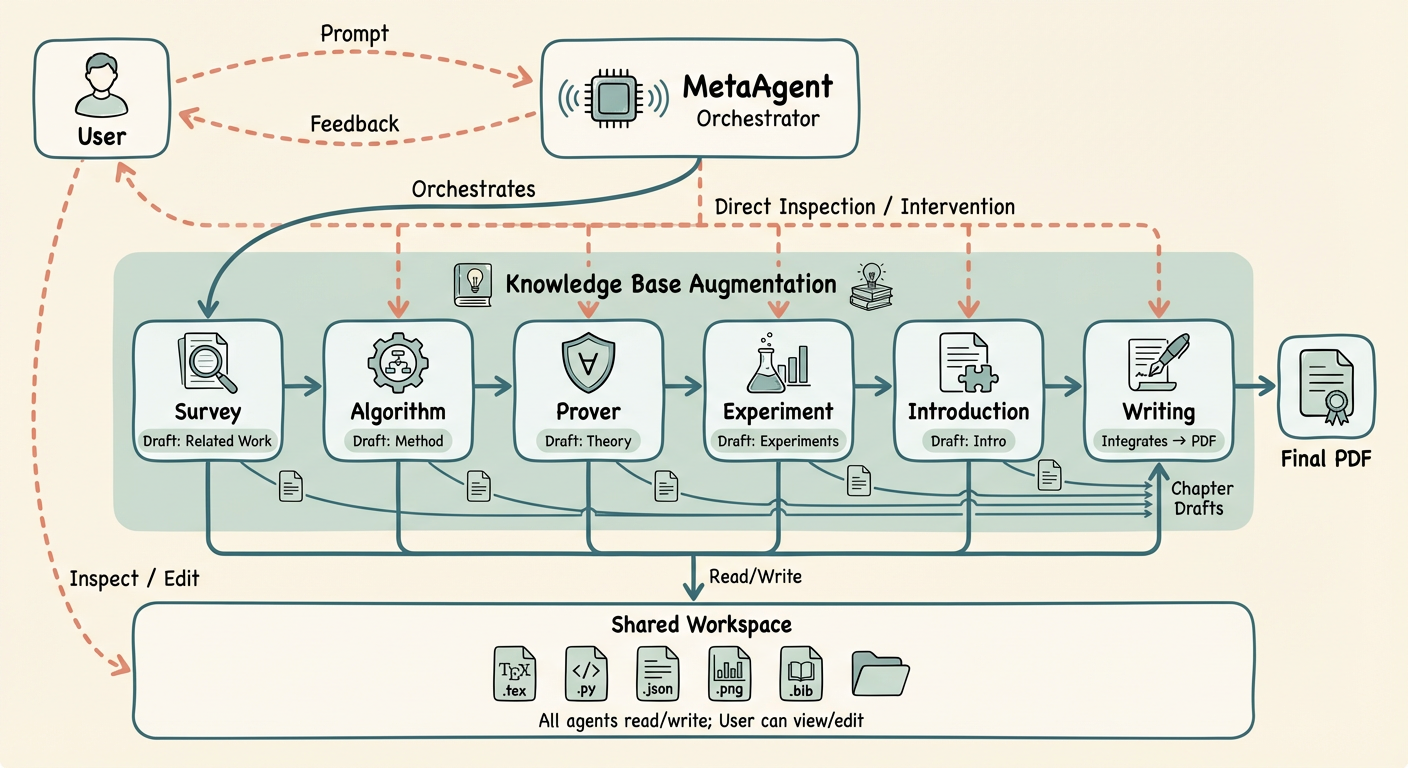
Figure 2. The ReasFlow multi‑agent workflow. MetaAgent dispatches tasks to SurveyAgent, AlgorithmAgent, ProverAgent, ExperimentAgent, IntroductionAgent, and WritingAgent, all sharing a common workspace with access to domain‑specific knowledge cards.
Each agent is equipped with specialized tools—from FAISS‑based literature search to LaTeX compilation and visual figure inspection—enabling a seamless transition from idea to publication‑ready draft.
Benchmark Performance
We rigorously evaluate ReasFlow against state‑of‑the‑art baselines across the entire research pipeline. Below we report results for full‑paper generation, literature survey, theorem proving, and introduction writing.
Full‑Paper Generation (End‑to‑End)
All systems were given identical prompts and references for Paper 1. ReasFlow is the only system to produce a complete, error‑free manuscript with full citation retention.
| AI Agent | Score 1 (GPT‑5.1) | Score 2 (GPT‑5.4) | Score 3 (Gemini‑3‑Pro) | Average |
|---|---|---|---|---|
| ChatGPT (GPT‑5.3) | 51.7 | 32.2 | 29.8 | 37.9 |
| ChatGPT Pro (GPT‑5.4‑Pro) | 62.4 | 44.5 | 41.9 | 49.6 |
| Gemini‑3.1‑Pro | 51.5 | 31.4 | 35.1 | 39.3 |
| Claude Pro (Claude Opus 4.6) | 64.4 | 32.9 | 61.4 | 52.9 |
| CycleResearcher‑ML‑12B | 34.6 | 19.1 | 10.1 | 21.2 |
| DeepScientist (GPT‑5.4) | 71.9 | 56.6 | 43.5 | 57.3 |
| AI Scientist‑v2 (GPT‑5.4) | 60.6 | 34.7 | 29.6 | 41.6 |
| ARIS (GPT‑5.4) | 59.3 | 52.9 | 38.6 | 50.3 |
| ReasFlow (GPT‑5.4) | 80.5 | 65.6 | 87.6 | 77.9 |
Table 1. Full‑paper evaluation scores. Bold indicates best.
SurveyAgent: Literature Review Quality
We compare the Related Work sections generated by SurveyAgent against base LLMs across three survey tasks. Each score is the total (Content Accuracy + Citation Relevance, out of 20) averaged across three evaluation models.
| Task | Backbone | Base LLM | ReasFlow | Advantage |
|---|---|---|---|---|
| Paper 1 (SFedAvg) | DeepSeek‑v3.2 | 12.65 | 17.93 | +5.27 |
| GPT‑5.1 | 19.20 | 17.78 | ‑1.41 | |
| GPT‑5.4 | 9.08 | 16.75 | +7.67 | |
| Sonnet 4.6 | 11.07 | 17.24 | +6.17 | |
| Paper 1 Average | 13.00 | 17.42 | +4.42 | |
| Paper 2 (Subspace) | DeepSeek‑v3.2 | 13.28 | 14.03 | +0.75 |
| GPT‑5.1 | 14.52 | 16.63 | +2.11 | |
| GPT‑5.4 | 13.23 | 16.15 | +2.92 | |
| Sonnet 4.6 | 14.03 | 14.90 | +0.88 | |
| Paper 2 Average | 13.77 | 15.43 | +1.66 | |
| Paper 3 (SUDA) | DeepSeek‑v3.2 | 8.14 | 18.36 | +10.23 |
| GPT‑5.1 | 7.00 | 16.03 | +9.03 | |
| GPT‑5.4 | 12.50 | 13.67 | +1.17 | |
| Sonnet 4.6 | 17.32 | 11.62 | ‑5.70 | |
| Paper 3 Average | 11.24 | 14.92 | +3.68 | |
| Overall Average | 12.67 | 15.92 | +3.26 | |
Table 2. SurveyAgent evaluation (Content Accuracy + Citation Relevance, max 20). The agent improves by +3.26 points on average, with the largest gain on harder tasks.
ProverAgent: Convergence Proof Generation
All systems were tasked with proving convergence of the Subspace SCAFFOLD algorithm under non‑convex stochastic settings. Scores are out of 100; Gemini‑3‑Pro evaluations are shown separately.
| AI Agent | Reasoning Effort | Score 1 (GPT‑5.1) | Score 2 (GPT‑5.4) | Score 3 (Gemini‑3‑Pro) | Average |
|---|---|---|---|---|---|
| ChatGPT (GPT‑5.3) | Default | 29 | 15 | 7 | 17 |
| Gemini‑3.1‑Pro | Default | 81 | 24 | 48 | 51 |
| ReasLingo (Gemini‑3‑Pro) | High | 91 | 48 | 40 | 59.7 |
| ReasLingo (GPT‑5.1) | High | 37 | 35 | 40 | 37.3 |
| ReasLingo (GPT‑5.4) | High | 92 | 57 | 60 | 69.7 |
| ProofGrader (GPT‑5.1) | High | 92 | 34 | 70 | 65.3 |
| ProofGrader (GPT‑5.4) | High | 93 | 39 | 75 | 69 |
| QED (GPT‑5.4) | High | 98 | 51 | 70 | 73 |
| ReasFlow (Gemini‑3‑Pro) | Medium | 91 | 62 | 100 | 84.3 |
| ReasFlow (GPT‑5.1) | Medium | 93 | 45 | 100 | 79.3 |
| ReasFlow (GPT‑5.4) | Medium | 94 | 78 | 100 | 90.7 |
Table 3. ProverAgent evaluation. ReasFlow achieves the highest average score and perfect marks from Gemini‑3‑Pro.
IntroductionAgent: Quality and Coverage
We compare the Introduction section generated by ReasFlow against the base model (GPT‑4o) across three papers. Each cell reports the mean over 5 independent runs. OB = Overall Balanced; OTF = Overall Technical Focus (weights method/evidence depth higher).
| Paper | Evaluator | Coverage (Base/RF) | Content Quality (Base/RF) | OB (Base/RF) | OTF (Base/RF) |
|---|---|---|---|---|---|
| Paper 1 | GPT‑5.1 | 0.482 / 0.621 | 0.372 / 0.564 | 0.554 / 0.683 | 0.520 / 0.661 |
| Claude‑Opus‑4.6 | 0.354 / 0.677 | 0.320 / 0.620 | 0.510 / 0.739 | 0.461 / 0.708 | |
| Gemini‑3.1‑pro | 0.489 / 0.674 | 0.610 / 0.830 | 0.677 / 0.795 | 0.658 / 0.788 | |
| Paper 1 Average | 0.441 / 0.657 | 0.434 / 0.671 | 0.580 / 0.739 | 0.547 / 0.719 | |
| Paper 2 | GPT‑5.1 | 0.455 / 0.492 | 0.400 / 0.490 | 0.552 / 0.642 | 0.509 / 0.603 |
| Claude‑Opus‑4.6 | 0.350 / 0.519 | 0.320 / 0.520 | 0.527 / 0.642 | 0.474 / 0.602 | |
| Gemini‑3.1‑pro | 0.348 / 0.519 | 0.650 / 0.640 | 0.656 / 0.705 | 0.629 / 0.672 | |
| Paper 2 Average | 0.384 / 0.510 | 0.457 / 0.550 | 0.578 / 0.663 | 0.538 / 0.625 | |
| Paper 3 | GPT‑5.1 | 0.360 / 0.495 | 0.304 / 0.580 | 0.465 / 0.648 | 0.418 / 0.622 |
| Claude‑Opus‑4.6 | 0.379 / 0.424 | 0.280 / 0.620 | 0.482 / 0.657 | 0.432 / 0.629 | |
| Gemini‑3.1‑pro | 0.382 / 0.452 | 0.450 / 0.780 | 0.587 / 0.734 | 0.548 / 0.719 | |
| Paper 3 Average | 0.374 / 0.457 | 0.345 / 0.660 | 0.511 / 0.679 | 0.466 / 0.657 | |
| Overall Average | 0.400 / 0.541 | 0.412 / 0.627 | 0.557 / 0.694 | 0.517 / 0.667 | |
Table 4. IntroductionAgent evaluation. ReasFlow consistently outperforms the base model across all metrics, with the most substantial gains in Content Quality (+52.3% on average).
📄 Generated Papers
📄 Blog PDF – ReasFlow-generated version. 🌐 arXiv – human‑refined version.